Normative generation
The system generates candidate norms from actors, possible actions, causal transitions, future deterioration paths, and group-level stability.
Law as computation
JudgeAI builds a normative model of the situation: affected actors, possible interventions, causal consequences, rejection conditions, and a group-aware selection rule. The result is not a search for similar rules, but a computable method for generating and choosing norms.
Core architecture
Normative Engine and AI Lawmaking use the consequence model as the generative core. AI Arbitration adds a legality filter because the output must be a lawful decision.
The system generates candidate norms from actors, possible actions, causal transitions, future deterioration paths, and group-level stability.
Dispute resolution keeps the same consequence ranking, but available outcomes are constrained by the record, contract, applicable law, and available remedies.
Proof route
The paper argues that autonomous normative choice needs an internal rejection criterion: a candidate norm must remain admissible after its consequences are modeled.
A norm must preserve real paths in which affected actors remain alive, functional, and able to act.
A rule changes access, obligations, resources, institutional position, exposure to harm, and future options.
One restriction can create another; a local burden may become serious deterioration through causal transitions.
Destabilizing one exposed group can trigger withdrawal, non-compliance, or secondary risk for others.
Model vocabulary
Each decision trace can be read through a small set of model objects: actor futures, restrictions, causal paths, evidence layers, threat scoring, and final selection.
The set of futures in which an actor remains alive, functional, institutionally capable, and able to pursue action.
A loss of real possibility: property, access, health, stability, institutional capacity, or the ability to prevent deterioration.
The case-specific map of links by which one restriction can create another under a candidate norm.
Present-layer data calibrates the current causal link; future-layer data calibrates how the link may branch over time.
A quantitative estimate of how strongly a candidate norm threatens an actor's viable trajectory space through causal chains.
The rule that selects the admissible option with the best worst-position profile across the interconnected actor group.
Product modes
The output changes by mode: policy choice, legal drafting, or dispute resolution. The internal object remains a modeled normative decision.
Compares available scenarios for public, social, or institutional dilemmas.
Produces a lawful decision from claims, defenses, contract terms, evidence, and admissible remedies.
Turns normative problems into structured bill text and an accompanying legislative report.
Evidence library
The materials below show the foundation of the method and examples of how the same model appears in product, lawmaking, and arbitration outputs.
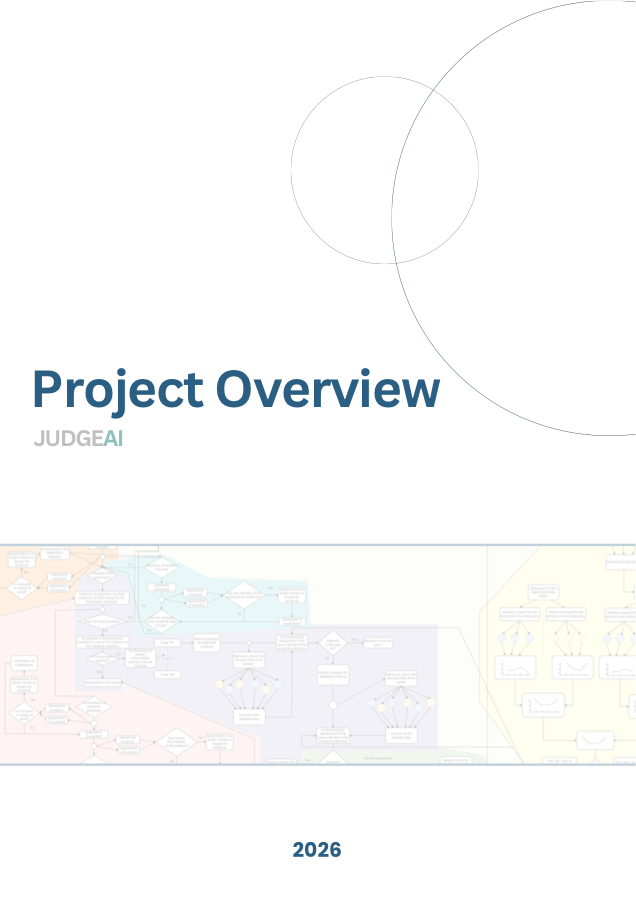
Company-level framing, product thesis, market positioning, and current implementation surface.
View document
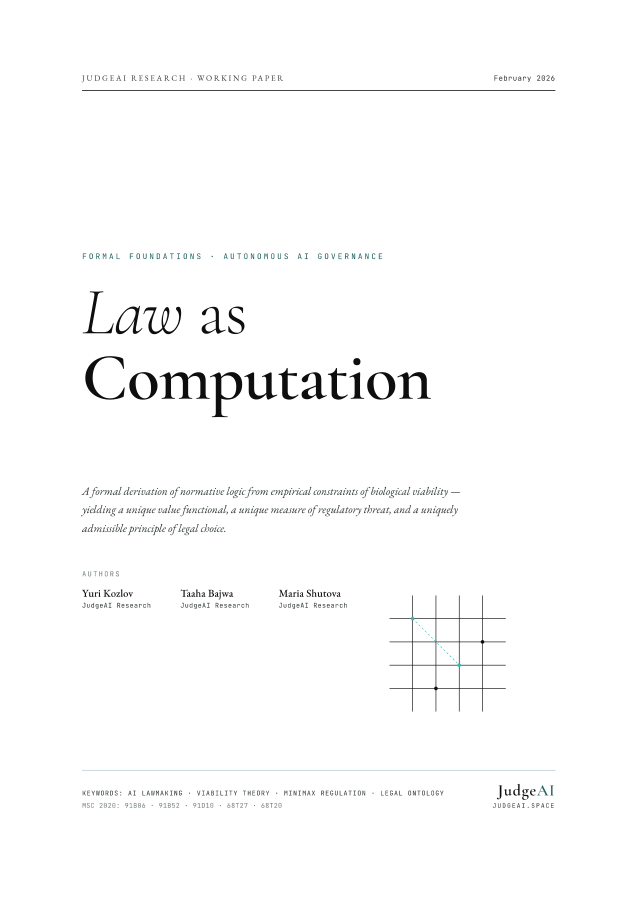
Research foundation for the internal rejection criterion, threat scoring, and group-aware selection rule.
View document
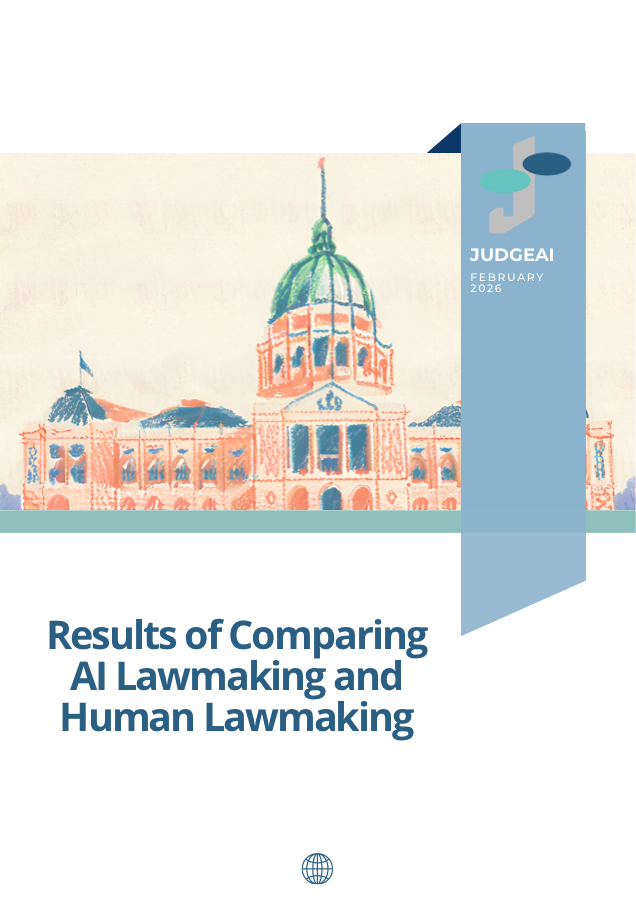
Testing result for JudgeAI Lawmaking: structured legislative text and an accompanying committee-style report.
View document
Testing result for JudgeAI as an AI Judge: party-record analysis, legality filtering, remedy selection, and decision formatting.
View documentReview access
Public readers can inspect the thesis and sample artifacts. Partners and technical reviewers can examine deeper traces, calibration records, benchmark runs, and deployment notes.
Core concept, architecture, product modes, example artifacts, and high-level validation story.
Benchmark runs, anonymized traces, regression history, and partner-specific implementation notes.
Prompt structures, scoring internals, internal maps, orchestration details, and non-public customer data.
The system turns normative problems into modeled alternatives, tests their consequences, and produces outputs in the form required by the task.